Buying Guide
Toggle navigation menu
Dust Guide

Dust Free Cat Litter: How Close You Can Actually Get

No litter is truly dust free. Here is what the claim on the bag means, which formats pour cleanest, and the three-minute test that settles it in your own home.

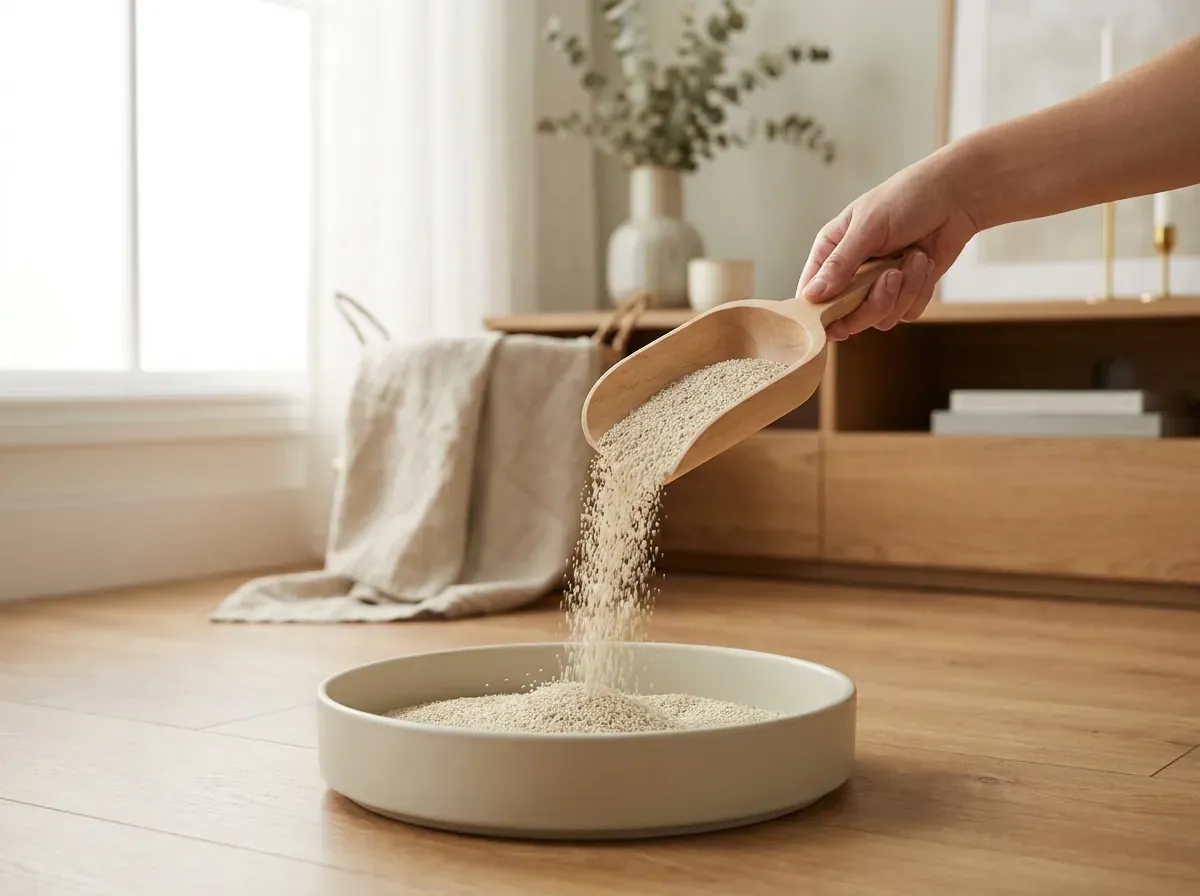
A hand pouring pale, fine-grain cat litter from a wooden scoop into a clean ceramic tray with no visible dust, in a calm sunlit room
Key Takeaways

What matters most

Nothing sold as dust free is genuinely dust free. Every dry granular litter throws some fine particles when it moves, so the useful question is how much and when.

The dust you notice comes from four moments: the pour, the dig, the scoop, and the walk-away. A litter can be clean in one of them and messy in another.

Format sets the ceiling, processing decides the result. Large crystals and pellets pour cleanest, but a well-made fine clay can beat a cheap plant powder.

Dust and odor are different problems. Cutting dust does nothing to ammonia, so plan for both instead of hoping one formula solves the room.

What The Claim Means

Dust free is a promise about degree, not a state the bag can reach

Start with the honest version. There is no dry granular litter that releases nothing when it is poured, dug in, and scooped. Grains rub against each other, the smallest fragments break loose, and some of them float. A bag that says dust free is telling you it releases less than the bag beside it, and that is a useful thing to know. It is not a state the product has reached.

That matters because nothing on the label tells you how the claim was measured, or at what point in the litter's life. Dust at the moment of pouring, dust after two weeks of digging, and dust from clumps that crumble on the scoop are three different results. A litter can look spotless coming out of the bag and still leave a grey film on the floor by week two.

So treat the phrase as a shortlist filter, not a verdict. Use it to pick two or three bags worth trying, then decide with the pour test, the scoop test, and your own floor. The rest of this page is about how to do that quickly and what each format is likely to do before you spend the money.

If the reason you are here is a cat that sneezes, hesitates at the box, or has been flagged by a vet as sensitive, start instead with our sensitive-cat guide, which treats fragrance and texture as seriously as particle size.
Why It Matters

Four moments decide how much dust ends up in the room

The pour

The biggest single cloud of the month happens when a full bag drops into an empty box. Height does most of the damage. Tipping from shoulder level gives the fines a long fall to spread out in. Bringing the bag down to the rim and pouring slowly cuts what you can see, whatever litter is inside.

The dig

Some cats scratch politely. Others excavate. An enthusiastic digger will lift fines out of any litter, which is why the same bag can be invisible in one house and obvious in another. If your cat covers with real commitment, weight the grain size question harder than the label claim.

The scoop

Clump strength is a dust story as much as a cleanliness one. A clump that lifts whole takes its fines with it. A clump that breaks on the scoop drops powder back into the box and into the air right in front of your face, which is the worst possible place for it.

The walk-away

Whatever leaves the box on paws lands on the floor, dries, and gets stepped on until it is part of the room. That is why tracking belongs in a dust conversation. The low-tracking guide covers the mat and box-shape side of that problem.

Airborne dust deserves caution rather than a shrug. OSHA's overview of crystalline silica is written for workplaces and not for litter boxes, but it is a fair reminder that fine mineral particles are worth keeping out of the air you breathe every day. OSHA overview If anyone in the home has a diagnosed respiratory condition, that is a conversation for their doctor and your vet, not for a buying guide.

Formats Compared

Six formats, and what each one usually does on dust

1. Well-processed clumping clay

The format most cats already accept, and the one with the widest quality spread. Better clay is screened and conditioned to knock out the fines before it reaches the bag, and it clumps hard enough that the scoop does not create new ones. Cheap clay does neither. If you like clay and want less dust, this is a case where the bag price genuinely tracks the result.

2. Crystal and silica gel

Large, hard pieces that pour with very little visible cloud, which is why crystal often wins the first impression. The tradeoff is texture. Some cats dislike the feel underfoot and start using the corner of the room instead, and dust means nothing if the box goes unused. Compare that risk in the crystal-litter guide.

3. Wood and pine pellets

Pellets are too big to float, so the pour is clean. What they do instead is break down into sawdust as they absorb, so the dust arrives later in the cycle rather than on day one. A sifting box moves that sawdust out from under the cat. See the wood-litter guide for how that setup works day to day.

4. Tofu and plant starch

Usually extruded into small uniform pellets, which keeps the pour tidy and the texture soft enough that most cats accept the change quickly. Quality varies by brand more than the category deserves, and lighter grains scatter, so check the floor around the box after the first week rather than trusting the first pour.

5. Recycled paper

Soft, light, and gentle on paws, which is why it turns up after surgery and in kitten setups. Paper pellets pour cleanly. Loose paper crumb is the version to watch, because it can shed a fine lint that behaves a lot like dust once it is on the floor. Details in the paper-litter guide.

6. Carbon and biochar blends

Black granules blended into a base litter for odor rather than for dust. They can look dramatic on a light floor even when the actual quantity is small, so judge them on the pour and on what your floor looks like, not on the colour of the first speck you notice. How activated carbon holds odor explains what the black granules are doing in there.

Dust Vs Odor

Cutting dust does nothing to the smell, and that surprises people

Dust is a particle problem. Odor is a gas problem. The smell that fills a room comes mostly from ammonia released as urine breaks down in the litter, and ammonia is a gas that walks straight past the finest grain you can buy. This is the single most common disappointment after a switch: the air looks cleaner, the box still announces itself.

The fix is not a finer litter. It is removing wet waste before it has time to break down, keeping enough depth for clumps to form properly, and giving the ammonia something to stick to. Activated carbon is the usual answer to that last part. It is the same material used in water filters, and it holds odor molecules on its surface instead of covering them with perfume. The store version of this page, Purrify's guide to low-dust litter and odor, walks through how the two problems interact.

If you would rather not change litter at all, an additive is the smaller move. Purrify is fragrance-free activated carbon made in Canada that you sprinkle over whatever litter your cat already accepts, which keeps the texture decision settled and puts the odor work somewhere else. You can see the bag sizes on purrify.ca if that is the gap you are actually trying to close.

At-Home Check

Test the claim in four quick moments

Pour test

Pour into a clean box with a lamp or a window behind it. Backlighting shows a cloud that a ceiling light hides completely. Do it the same way every time or you are comparing your own pouring, not the litter.

Scoop test

Wait for a real clump, then lift it slowly. If it holds together and the scoop comes up clean, the litter is doing its job. If it sheds powder back into the box, the dust problem will get worse every week, not better.

Floor test

Wipe a dark tile or a dark cloth a metre from the box after a week. That grey film is the honest measurement, and it catches tracked fines that never showed up as a visible cloud.

Acceptance test

Watch the cat for a few days. Hesitating at the entrance, shaking paws on the way out, or digging less than usual all mean the texture is wrong. The dust question is not solved if the box stops getting used.

Change one thing at a time and give it a week. Swapping litter, box, and mat in the same afternoon leaves you with no idea which change helped. If you are moving away from a formula your cat likes, transition gradually with the step-by-step switching guide rather than replacing the whole box overnight. Merck and Cornell both make the same point from the cat's side: a box that feels wrong gets avoided, and an avoided box is a bigger problem than dust ever was.

FAQ

Common questions about dust free cat litter

Is dust free cat litter actually dust free?

No. Any dry granular litter releases some fine particles when it is poured, scooped, or dug in. "Dust free" on a bag is a marketing phrase, not a measurement, and no shared test sits behind it. Read it as "less dust than the litter beside it on the shelf" and judge the bag in your own room.

Which litter type is lowest in dust?

It depends more on how a litter is processed than on what it is made of. Crystal and pellet formats usually pour with the least visible cloud because the pieces are large. Fine-grain clay and plant powders vary enormously between brands, so the format tells you less than the pour test does.

Does dust free also mean low tracking?

Not automatically. Dust is what hangs in the air; tracking is what your cat carries out of the box on its paws. A litter can pour cleanly and still scatter across the floor, and tracked fines eventually become house dust anyway, so it is worth checking both.

Can I make the litter I already buy less dusty?

Somewhat. Pour slowly and low into the box instead of tipping from shoulder height, keep the depth in the range the box needs rather than overfilling, and scoop before clumps have a chance to crumble. None of that changes the formula, but it removes the moments when most of the dust actually goes airborne.

Does low dust mean weaker odor control?

They are separate jobs. Dust is a particle problem and odor is a gas problem, mostly ammonia coming off urine as it breaks down. A litter can be very low dust and still let the box smell, which is why odor is usually solved with faster scooping and an adsorbent rather than with a finer grain.

Does low dust always mean safer?

Not automatically. Low dust is helpful, but you still need to look at the full formula, the fragrance level, and whether the cat accepts the texture. A litter can be low dust and still be a poor fit for a sensitive cat.

Written and reviewed by the Premium Cat Litter editorial team, and checked against the sources cited above. Read how we research and correct our work in our editorial policy.

Compare Dust Against the Rest of Your Buying Criteria

Use the full guide if you need to balance dust reduction with clumping, odor control, cost, and multi-cat performance.